Categories
Stability Wind Farms

Grid forming converter in CIGRE 928 benchmark system

For both grid-following (GFL) and grid-forming (GFM) control, the same hardware structure is used, specifically an IGBT-based two-level voltage-sourced converter (VSC) with a 12 MW rating. This converter is connected to the plant via a 0.69/66 kV transformer, with the grid-side reactance of the LCL filter acting as the step-up transformer.

The converter control is configured to operate in grid-forming mode, using vector control in the dq-reference frame. The control system includes the following components: power calculation, power regulation, voltage regulation, current regulation, and pulse-width modulation (PWM). Additionally, an active damping control utilizing feedback from the series reactor current is considered.

Subsystems of grid-forming converter

Anti-aliasing filtering and sampling: The anti-aliasing filter is a second-order Butterworth filter, with a cut-off frequency set to half the sampling frequency. Sampling delays are approximated using a third-order Padé formula.

Park transformation: Grid-forming control is implemented in a reference frame synchronized to an arbitrary input, provided in per unit (p.u.), where the reference frequency (f*) is set to 1. In practical applications, the phase can be provided by a low-bandwidth phase-locked loop (PLL) that slowly tracks the system frequency.

Power calculation: Instantaneous active and reactive power are calculated based on voltage and current measurements taken at the LCL filter's output.

Power regulation: In GFM mode, power synchronization control generates the reference for the voltage angle, while reactive power control sets the reference for the voltage amplitude. Active and reactive power droop characteristics are combined with a simple low-pass filter.

Voltage regulation: The voltage is controlled through a proportional-integral (PI) regulator, ensuring zero steady-state error. Active damping is also incorporated to enhance noise rejection and system stability.

Current regulation: A proportional (P) controller manages the current, as the integral (I) component is unnecessary; the voltage regulator already handles tracking the voltage reference. Adding complexity to the current regulator may adversely affect converter stability.

PWM: The modulation block calculates the switching functions and sends pulse patterns to the converter's gate drivers. The PWM delay is also accounted for in this block.

Note: The proposed GFM control does not include DC voltage regulation. It is assumed that the GFM converter maintains a stable DC link voltage, such as from a battery energy storage system (BESS), so DC voltage control is unnecessary.

Benchmark grid forming converter control block diagram.

Grid-forming converter parameters

The electrical circuit for GFM unit is assumed to be the same as for GFL converter. The control structure is visualized in figure below.

List of parameters in the grid forming converter control system.

References

[1] Ł. Kocewiak, Ch. Buchhagen, R. Blasco-Gimenez, J. B. Kwon, M. Larsson, Y. Sun, X. Wang et al., “Multi-frequency stability of converter-based modern power systems,” Technical Brochure 928, Page(s) 1-147, CIGRE, March 2024.

Categories
Measurements Stability Wind Farms

Grid following converter in CIGRE 928 benchmark system

The primary objective of the benchmark model is to serve as a reference for studying interactions between converters and the grid. It provides a foundation for evaluating small-signal stability analysis methods and instability mitigation techniques. The model includes aggregated grid following (GFL) converters, interconnected via a medium-voltage (MV) cable network.

The model is inspired by a real-life AC cable-connected offshore wind power plant (PP). The GFL converter model is a part of benchmark system, introduced by CIGRE WG C4.49 and published in the CIGRE 928 technical brochure.

The model is developed in the dq-reference frame to simplify modelling and avoid coupling in the control system. The converter is based on a standard insulated-gate bipolar transistor (IGBT)-based two-level voltage source converter (VSC), rated at 12 MW, as typically seen in modern offshore wind turbines (WTs). To simplify the analysis, the mechanical system and its controllers are not included.

Converter control is designed as GFL unit, employing vector control in the dq-reference frame and a synchronous reference frame (SRF) phase-locked loop (PLL) for grid synchronization. The dq currents regulate the DC link voltage and either the voltage or reactive power at the converter terminals. Active damping control, using capacitor current feedback, is also incorporated to enhance stability.

The converter system is linked to the grid through a 0.69/66 kV transformer, where the low-voltage reactance corresponds to the grid-side reactance of the LCL output filter.

Benchmark grid following converter control block diagram.

Subsystems of grid-following converter

The converter control system has been tuned to mimic the behavior of a generic converter model and has not yet been customized for the specific grid under study. As a result, various instabilities may arise in both the base case and during disturbance scenarios.

Anti-aliasing Filter and Sampling: the anti-aliasing filter is implemented using a second-order Butterworth filter, with the cutoff frequency set at half of the sampling frequency and the sampling delay is approximated using a third-order Padé approximation.

Park Transformation: the GFL control is implemented in a synchronous reference frame (SRF), with the phase determined by a phase-locked loop (PLL) that tracks the system frequency.

Power Calculation: instantaneous active and reactive power are calculated from voltage and current measurements taken at the output of the LCL filter.

DC Voltage Control: the DC voltage regulation is managed through a proportional-integral (PI) controller.

AC Voltage Control: the AC voltage regulation is implemented using a simple droop control method.

Reactive Power Control: the reactive power regulation is handled by a proportional-integral (PI) controller.

Phase-Locked Loop (PLL): the grid synchronization system uses a PLL, where the voltage’s q-component is filtered by a first-order low-pass filter and regulated by a PI controller, which provides the system’s angular frequency, which is then integrated to determine the phase for the Park transformation.

Current Control: the converter reactor current regulation is achieved using PI controllers with decoupling in the SRF, and active damping is incorporated to attenuate the capacitor current in the LCL filter, and an output voltage feed-forward component is added to the voltage reference.

Pulse Width Modulation (PWM): the modulation block computes the switching functions and provides the pulse patterns to the converter gate drivers and the PWM delay is also included.

Grid following converter parameters

List of parameters in the grid following converter electrical circuit.
List of parameters in the grid following converter control system.

References

[1] Ł. Kocewiak, R. Blasco-Gimenez, C. Buchhagen, J. B. Kwon, M. Larsson, Y. Sun, X. Wang, “Practical Aspects of Small-signal Stability Analysis and Instability Mitigation,” in Proc. The 21st Wind & Solar Integration Workshop, 12-14 October 2022, The Hauge, The Netherlands.
[2] Ł. Kocewiak, R. Blasco‐Giménez, C. Buchhagen, J. B. Kwon, M. Larsson, A. Schwanka Trevisan, Y. Sun, X. Wang, “Instability Mitigation Methods in Modern Converter-based Power Systems,” in Proc. The 20th International Workshop on Large-Scale Integration of Wind Power into Power Systems as well as Transmission Networks for Offshore Wind Farms, Energynautics GmbH, 29-30 September 2021.
[3] Ł. Kocewiak, R. Blasco‐Giménez, C. Buchhagen, J. B. Kwon, Y. Sun, A. Schwanka Trevisan, M. Larsson, X. Wang, “Overview, Status and Outline of Stability Analysis in Converter‐based Power Systems,” in Proc. The 19th International Workshop on Large-Scale Integration of Wind Power into Power Systems as well as Transmission Networks for Offshore Wind Farms, Energynautics GmbH, 11-12 November 2020.

Categories
Methodology Stability Wind Farms

CIGRE C4.49: Multi-frequency stability of converter-based modern power systems

Background

Nowadays, it is seen that the rapid transformation of power systems from conventional with high natural damping, short-circuit current and natural inertia to power-electronic-based with limited damping, fault infeed and inertia may trigger unstable operation, if not investigated carefully. Moreover, the electrical infrastructure is becoming more complex due to the introduction of long high voltage alternating current (HVAC) cables, high voltage direct current (HVDC) connections, widespread penetration of renewable energy sources, e.g. photovoltaic (PV) plants, wind power plants (PPs), and offshore electrical network development. This power system transformation creates challenges such as operational coordination of grid-connected converters and small-signal stability assurance both in the sub-synchronous and harmonic (super-synchronous) frequency regions.

Motivation

The increased use of power electronic converters in modern electrical systems creates challenges w.r.t. power system stability assurance but also simultaneously provides wide range of power system performance and stability enhancement solutions. Better understanding about the application of various instability mitigation methods, including impact on power system performance, use depending on instability root cause, implementation methodology, is needed. Power system operators, operators of renewable PPs, transmission solution developers, renewable generation developers, academic units and original equipment manufacturers expect coordinated effort to understand when and how to apply specific mitigation measures.

Therefore, the overview, status and outline of instability mitigation methods in converter-based modern power systems is needed. Thus, the CIGRE C4.49 working group entitled “Multi-frequency stability of
converter-based modern power systems” was established. The instability phenomena, instability root cause and suggests optimal mitigation measures are investigated within the working group. Moreover, guidelines regarding the general approach how to choose optimal instability mitigation method will be suggested in the technical brochure.

Scope

  1. Review of existing literature regarding subject related stability issues including state-of-the-art converter stability aspects.
  2. Definition of stability phenomenon to be covered within the technical brochure.
    • Stability effects above the fundamental frequency, i.e. harmonic stability.
    • Small-signal stability below the fundamental frequency, i.e. sub-synchronous stability.
    • Clarification of definitions to avoid misinterpretation with steady-state harmonics and classical harmonic propagation analysis.
    • Symptoms and root causes of sub-synchronous and harmonic stability phenomenon.
    • Examples of sub-synchronous and harmonic stability phenomena observed and their impact on wider power systems.
  3. The impact of grid-connected converter controllers on sub-synchronous and harmonic stability phenomenon.
    • Classification of typical controllers used in modern converters.
    • Evaluation of various control loops and techniques and their impact on stability, e.g. voltage control, current control, phase-locked loop.
    • Frequency range of interest and controller interactions/couplings.
  4. Overview of linear modelling and analysis methods to perform small-signal stability studies, e.g.
    • Classical control theory approach of linear time-invariant systems, i.e. compensator and plant interactions, and possible general extension to linear time varying systems including e.g. linear time-varying periodic systems.
    • Impedance-based stability criterion.
    • Advantages and disadvantages of single-input single-output and multiple-input multiple-output representation.
    • Relevant stability evaluation methods, e.g. eigenvalue analysis, Nyquist criterion.
  5. Other analysis techniques.
    • Time-domain numerical simulations of linear and non-linear systems.
    • Frequency and sequence coupling investigation.
    • Stability of non-linear dissipative dynamic systems including e.g. limit cycle and bifurcation theory investigation.
  6. Description of mitigation methods to overcome sub-synchronous and harmonic stability issues, e. g.
    • Clear evaluation criteria and minimal requirements regarding the stability indices, e. g. stability margins, damping.
    • Recommendations to address plant resonance profile at early stage during the grid-connected converter controller design.
    • Converter coordination guidelines in modern power systems to avoid potential instability, e. g. passivity requirements.
    • Mitigation measures incorporated in the grid-connected converter control (e.g. active damping) or within the power system electrical infrastructure (e.g. passive damping), also at later stage of project development or during operation.
  7. Guidelines on general approach to such studies and the availability as well as choice of tools. Identification of limitations with the available analysis tools and suggestion of possible areas for development.

References

Ł. Kocewiak, R. Blasco‐Giménez, C. Buchhagen, J. B. Kwon, M. Larsson, A. Schwanka Trevisan, Y. Sun, X. Wang, “Instability Mitigation Methods in Modern Converter-based Power Systems,” in Proc. The 20th International Workshop on Large-Scale Integration of Wind Power into Power Systems as well as Transmission Networks for Offshore Wind Farms, Energynautics GmbH, 29-30 September 2021.

Ł. Kocewiak, R. Blasco‐Giménez, C. Buchhagen, J. B. Kwon, Y. Sun, A. Schwanka Trevisan, M. Larsson, X. Wang, “Overview, Status and Outline of Stability Analysis in Converter‐based Power Systems,” in Proc. The 19th International Workshop on Large-Scale Integration of Wind Power into Power Systems as well as Transmission Networks for Offshore Wind Farms, Energynautics GmbH, 11-12 November 2020.

Categories
Harmonics Wind Farms

Active filtering vs. passive filtering

Let us think about various sources of harmonic problems in large wind power plants (WPPs) and different ways of optimized harmonic mitigation methods. We discussed previously about harmonic problems such as sources of harmonic emission and amplification as well as harmonic stability which are commonly seen in large WPPs. Fortunately a significant variety of modern preventive and remedial harmonic mitigation methods in terms of passive and active filtering are possible.

Passive filtering

Three-phase harmonic filters utilized in the WPPs nowadays are shunt elements. They are intended to decrease the voltage distortions at the point of interest. From the grid code requirements point of view, a WPP voltage distortion is evaluated at the point of common coupling (PCC).
Nonlinear elements such as the power electronic converters, transformers, etc. generate harmonic currents or harmonic voltages inside the WPP as well as in the external network. The resultant harmonic current flows throughout system impedance. Passive harmonic filters reduce distortion by providing low impedance to the harmonic currents.
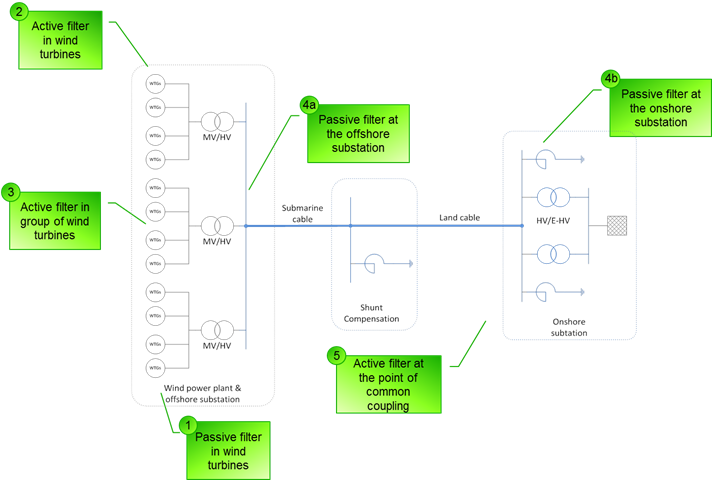
Typical shunt harmonic filters are presented in Fig. 1. Such filtering depending on the harmonic emission source can be installed either in the wind turbine circuit or somewhere at the WPP level (e.g. onshore substation, offshore substation, etc.).

Pros

  • Known state-of-the-art technology,
  • Relatively cheap solution,
  • High reliability due to simplicity in the build,
  • Effective if designed correctly.

Cons

  • Significant size especially for lower frequencies (for large WPPs the tuned frequencies are getting lower),
  • Additional losses,
  • Can cause some over-voltages during switching operations (e.g. energization),
  • Tuned only for specific frequencies (i.e. limited bandwidth),
  • Affected by uncertainties during the WPP design phase,
  • Cannot be easily re-tuned in the case of changing grid conditions during the operation of the WPP,
  • Uncertainties in terms of sizing due to lack of information from wind turbine manufacturers and TSOs during the design phase,
  • Size limitations during design due to e.g. limited space at offshore substation,
  • Long lead-time because of custom-made reactors.

Active filtering

All active filtering solutions employ power electronic converters for the absorption (e.g. harmonic compensation) or suppression (e.g. active damping) of harmonics. Nowadays large WPPs are already equipped with a number of grid connected converters either as a part of the wind turbines or as some sort of FACTS devices. In that case, the implementation of active filtering technique would only mean the retuning of the converter controller in order to meet with controlled harmonic levels.
The converter might be controlled adaptively or otherwise to suppress the selected critical harmonic components. From this perspective there is no need to interfere with the WPP design but it entails to providing additional control features. Such issues could be specified on a contractual level and required to be provided as an add-on together with the product.
Connecting all possible active filtering methods together with state-of-the-art passive filtering methods an optimized hybrid solution can be obtained.

Pros

  • Already existing technologies such as STATCOMS can be utilized for the active filtering at the PCC,
  • Active tuning might be permissible even during the operation,
  • Almost unlimited control potential (e.g. selective harmonic compensation, wide band high-pass active filtering, etc.),
  • Network impedance changes during operation could be addressed,
  • Control method can be tuned for each of WPPs independently taking into consideration grid code issues as well as WPP structure,
  • Negligible losses for series connected active filters such as wind turbines,
  • Reduces risk due to uncertainties related with lack of information from manufacturers (e.g. models) and TSOs (e.g. harmonic background, models, etc.).

Cons

  • Recent technology; not commonly applied in WPPs,
  • May suffer from harmonic stability problems,
  • Improved bandwidth and increased switching frequency is needed,
  • Component sizing issues and limited DC-link voltage utilization.

[1] Ł. H. Kocewiak, "Harmonics in Large Offshore Wind Farms," PhD Thesis, Aalborg University, Aalborg, 2012.
[2] Ł. H. Kocewiak, S. K. Chaudhary, B. Hesselbæk, "Harmonic Mitigation Methods in Large Offshore Wind Power Plants," in Proc. of The 12th International Workshop on Large-Scale Integration of Wind Power into Power Systems as well as Transmission Networks for Offshore Wind Farms, Energynautics GmbH, London, UK, 22-24 October 2013, 443-448.

Categories
Harmonics Wind Farms

Harmonic mitigation methods in wind power plants

There are various techniques for dealing with the harmonic problem in large wind power plants (WPPs) depending upon the nature and source of the problem.
Large offshore WPPs are characterized by complex structures including wide application of power electronic devices in wind turbines, FACTS devices and/or HVDC transmission. Moreover, there is a large amount of passive components such as filters, cable arrays, transformers, transmission cables, and shunt compensation equipment. Consequently, there are many potential sources of harmonic problems, and simultaneously many ways of dealing with them [1].
Primarily there are two methods of harmonic mitigation in a WPP: (i) avoiding harmonic resonance by design and (ii) design and use of filters [2]. A good design involves system layout, component selection and controller tuning with the aim of avoiding potential resonance conditions in the WPP.

Harmonic mitigation methods
Fig. 1 Harmonic mitigation methods in wind power plants.

Both passive and active filtering could be used for harmonic mitigation. It is recognized that passive filtering is the state-of-the-art technology. However, it requires extensive knowledge of the system during the WPP design phase. In many cases information about the system is uncertain and over-sizing of passive filters may take place to cover uncertainties and risks.
Due to the fact that more and more power electronic equipment (e.g. wind turbines with grid connected converter, STATCOMs, HVDC, etc.) is being utilised in WPPs, active filtering appears to be an interesting solution.
Active filtering can be implemented at the converter control level, thereby avoiding or reducing the need for installing expensive passive filters. Moreover, active filter controllers could be tuned and re-tuned, sometimes adaptively, to overcome the uncertainties faced during the WPP design phase [3].
A comparison between passive and active filters including major factors is presented in Table 1. It can be easily seen that there is a potential in active filtering and the technology is improving.

Table 1 Comparison between passive and active filtering technology.

Indices Passive filters Active filters
Technology Known Improving
Reliability High Medium
Effectiveness Medium Good
Engineering time Large Medium
Power electronics No Yes
Energy storage Large Small
EMI No Yes
Control circuit No Yes
Voltage regulation No Yes
Dynamic response Slow Fast
Cost Low High

Considering the different attributes, probably hybrid solutions involving both the passive and the active filters at various locations, as shown in Fig. 1, would be the most beneficial for effective harmonic mitigation scheme. In order to optimize the WPP design from harmonic emission and stability perspective some more studies and research is required [4]. The hybrid solutions would comprise of:

  1. Passive filtering at the wind turbine level:
    • trap filters designed for carrier group harmonics filtering,
    • high-pass filters for high frequency content,
    • detuned C-type filters with limited bandwidth, etc.
  2. Active filtering at the wind turbine level:
    • selective harmonic compensation,
    • high-pass active filtering,
    • harmonic rejection capability,
    • active notch filters, etc.
  3. Active filtering in groups of wind turbines:
    • carrier signals de-synchronization,
    • phase shifter transformer groups, etc.
  4. Passive filtering at the WPP level – 4b) onshore or 4a) offshore:
    • detuned C-type filters,
    • double-tuned filter, etc.
  5. Active filtering at the WPP level:
    • shunt connected FACTS devices,
    • HVDC link, etc.

[1] V. Akhmatov, J. Nygaard Nielsen, J. Thisted, E. Grøndahl, P. Egedal, M. Nørtoft Frydensbjerg, and K. Høj Jensen, "Siemens Wind Power 3.6 MW Wind Turbines for Large Offshore Wind Farms," in Proc. 7th International Workshop on Large Scale Integration of Wind Power and on Transmission Networks for Offshore Wind Farms, 26-27 May 2008, pp. 494-497.
[2] M. Bradt, B. Badrzadeh, E. Camm, D. Mueller, J. Schoene, T. Siebert, T. Smith, M. Starke, and R. Walling, “Harmonics and resonance issues in wind power plants,” 2011 IEEE PES General Meeting, Jul. 2011.
[3] Ł. H. Kocewiak, "Harmonics in Large Offshore Wind Farms," PhD Thesis, Aalborg University, Aalborg, 2012.
[4] P. Brogan, "The stability of multiple, high power, active front end voltage sourced converters when connected to wind farm collector systems," in EPE Wind Energy Chapter Seminar, Stafford, 2010, pp. 1-6.