In product development, strong execution is not enough without a clear strategic direction. Teams often move fast, deliver features, and manage busy backlogs. However, without strategy, this work can become reactive and fragmented. Product strategy defines the long-term vision, the problems worth solving, and the outcomes the product should achieve to be successful. It helps teams make better decisions about what not to build and where to focus their limited resources. When strategy is clearly defined and connected to tactical roadmaps and operational backlogs, daily development work supports real business and user value. This alignment ensures that product teams are not just shipping features, but building the right product over time.
Planning works best in layers
Many teams struggle with planning because everything gets mixed together. Vision, roadmap, and daily tasks end up in one place. The result is confusion and risk of constant reprioritization.
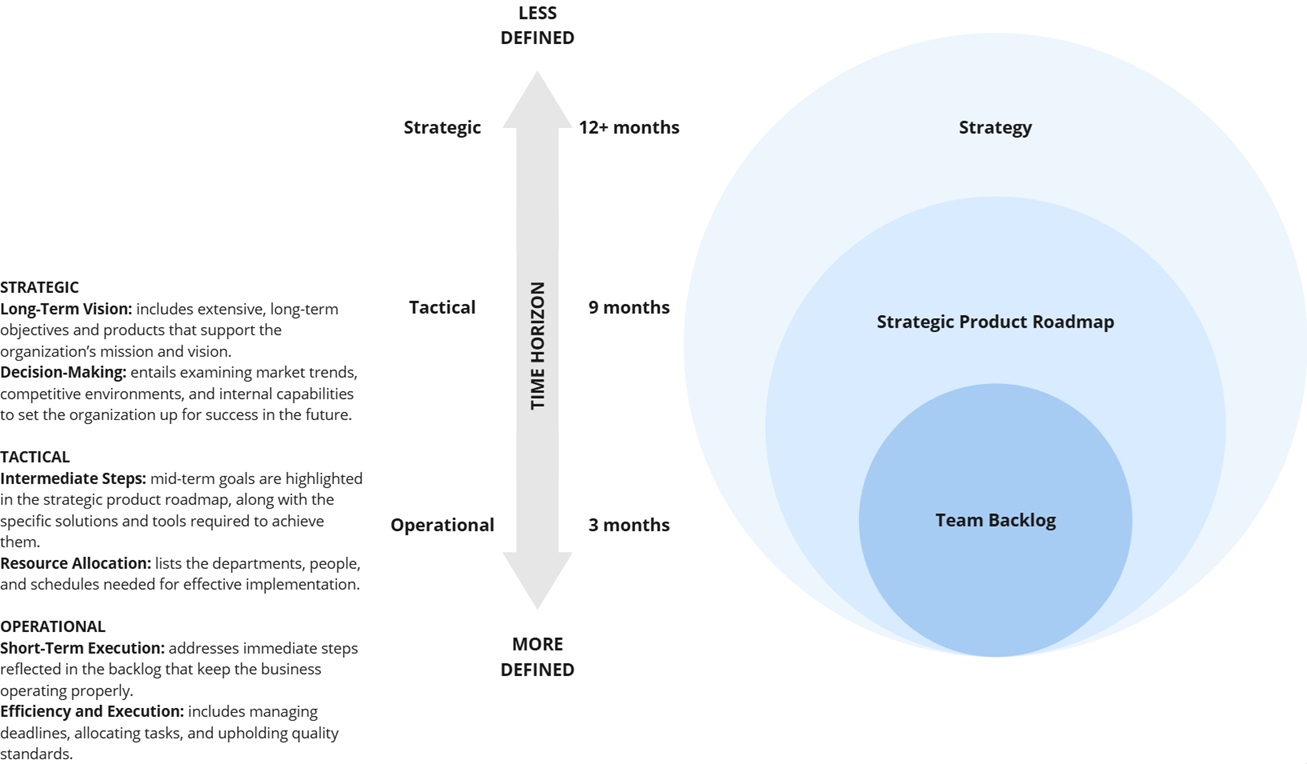
The framework in the image shows a simple truth:
Good planning happens on three levels – strategic, tactical, and operational.
Each level answers a different question:
- Strategic – Where are we going?
- Tactical – How will we get there?
- Operational – What are we doing now?
The further you move toward execution, the more detailed the work becomes.
Strategic planning – direction and long-term focus
At the top of the diagram is Strategy. This is the broadest and least defined layer.
The time horizon is 12+ months.
Strategic planning focuses on:
- Long-term vision and goals
- Market trends and opportunities
- Competitive positioning
- Major product or business bets
At this level, decisions are directional, not detailed. You define outcomes, themes, and priorities – not features or tasks.
Strategy answers:
What future are we building toward?
Because the horizon is long, uncertainty is high. That is why this layer is shown as “less defined.”
Tactical planning – turning strategy into a roadmap
The middle layer in the image is the Strategic Product Roadmap. This is the tactical level.
The time horizon is around 9 months.
Tactical planning translates strategy into:
- Key initiatives or epics
- Milestones and sequencing
- Resource planning
- Dependencies across teams
This is where strategy becomes actionable. You still focus on outcomes, but now you define what needs to happen to get there.
Tactical planning answers:
Which initiatives will move the strategy forward?
It provides alignment without locking teams into detailed execution too early.
Operational planning – execution and delivery
At the bottom of the diagram is the Team Backlog. This is the operational layer.
The time horizon is about 3 months or less, i.e. one Program Increment or Planning Interval.
Operational planning includes:
- User stories and tasks
- Sprint (or Iteration) planning
- Daily execution
- Delivery tracking and quality
This level is highly defined. Work is broken down, estimated, and assigned.
Operational planning answers:
What are we delivering right now?
This is where plans meet reality. Changes happen often, and that is expected.
The connection between the three layers
The visual shows three important relationships:
Time horizon
- Strategy: long term
- Roadmap: mid term
- Backlog: short term
Level of detail
- Strategy – broad and flexible
- Tactical – structured but adaptable
- Operational – specific and concrete
Alignment flow
Strategy → Roadmap → Backlog
When this flow works:
- Teams understand the purpose behind their work
- Leadership sees how execution supports strategy
- Priorities change less often
- Planning conversations happen at the right level
The key principle is simple:
Strategy should guide execution, but execution should not replace strategy.
In short
Strategic, tactical, and operational planning work together to turn vision into results. Strategic planning sets the long-term direction and defines where the organization wants to go over the next 12 months or more. Tactical planning translates this vision into a mid-term product roadmap, outlining the key initiatives and priorities needed to move the strategy forward within the next several months. Operational planning focuses on short-term execution through the team backlog, where work is broken down into concrete tasks and delivered. As the time horizon becomes shorter, the level of detail increases. When these three layers are clearly connected, teams stay aligned, priorities become more stable, and daily work consistently supports long-term goals.
References
[1] Marty Cagan, “Inspired: How to Create Tech Products Customers Love,” Wiley, 2017.
[2] Scaled Agile Framework (SAFe), “Roadmap,” URL: https://framework.scaledagile.com/roadmap/, Last Update: 25 February 2025.
[3] Roman Pichler, “Strategize: Product Strategy and Product Roadmap Practices for the Digital Age,” Pichler Consulting, 2022.
