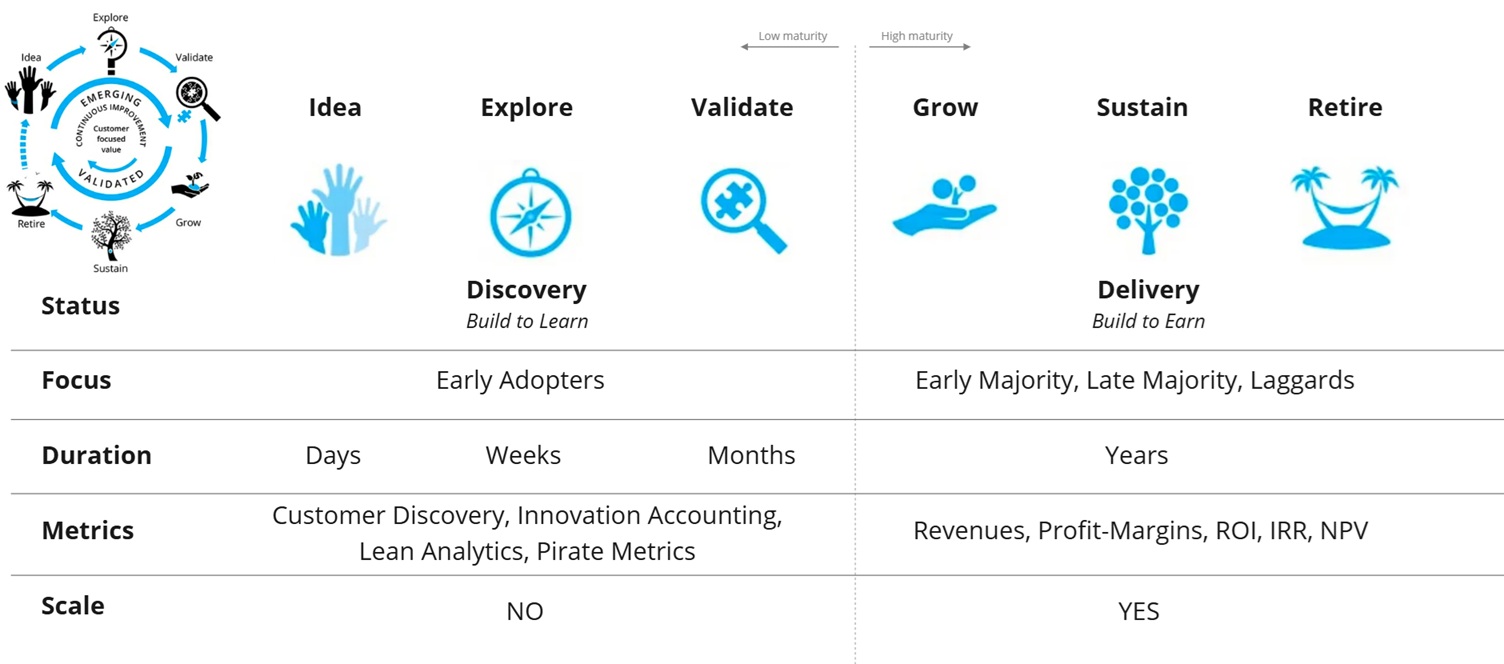
Product Lifecycle Management (PLM) describes how a product evolves from an initial idea to eventual retirement. The lifecycle helps organizations manage uncertainty in early stages while focusing on growth and profitability once a product proves its market fit. Each of 6 phases has a different purpose, timeframe, and success metrics. Early stages (i.e. Idea, Explore, Validate) emphasize learning and experimentation with potential customers, while later stages (e.g. Grow, Sustain, Retire) focus on scaling, operational efficiency, and financial performance. Understanding these phases helps allocate people effectively and manage products throughout their entire lifecycle.
Idea
The Idea phase is where potential product opportunities are identified. Teams recognize customer problems, unmet needs, or market gaps that could lead to valuable solutions. Ideas may come from customer feedback, technological advances, internal innovation, or strategic business goals. At this stage, concepts are still rough hypotheses rather than defined products. The goal is to quickly assess whether the opportunity is worth exploring further. Activities typically include problem framing, initial discussions, and collecting early insights from users or the market.
Explore
The Explore phase focuses on understanding the problem space and identifying possible solution approaches. Teams conduct research to learn about user needs, behaviors, and market conditions. The objective is to confirm that the problem is real and significant. Activities may include user interviews, market analysis, early concept sketches, and exploratory prototypes. Multiple ideas can be evaluated during this phase. The emphasis is on learning and reducing uncertainty before committing significant development effort.
Validate
The Validate phase tests whether the proposed solution effectively solves the identified problem and creates value for users. Teams develop prototypes or minimum viable products (MVPs) and test them with early adopters. Experiments and usability testing help verify assumptions about desirability, usability, and feasibility. Metrics such as user engagement, activation, and retention are often monitored. The aim is to confirm product–market fit and ensure that the solution is viable before scaling development and investing in broader delivery.
Grow
The Grow phase begins once the product has demonstrated clear value and product–market fit. The focus shifts to increasing adoption and expanding the customer base. Teams improve reliability, performance, and user experience while adding features that strengthen the product’s value proposition. Marketing and distribution efforts intensify to reach a wider audience. Infrastructure and support capabilities are also scaled to accommodate growth. Key indicators during this phase include adoption rates, revenue growth, and customer retention.
Sustain
The Sustain phase represents the maturity of the product. Adoption has stabilized and the product delivers consistent value to customers and the business. Development efforts emphasize incremental improvements, reliability, and operational efficiency rather than major innovation. Teams focus on maintaining competitiveness through updates, performance improvements, and cost optimization. Financial indicators such as profitability, margins, and operational efficiency become important measures of success as the product continues serving established customer segments.
Retire
The Retire phase marks the end of the product lifecycle when the product is gradually phased out or replaced. This may occur due to declining demand, technological change, or the introduction of more advanced solutions. The main objective is to manage the transition responsibly while minimizing disruption for users. Organizations typically communicate end-of-life plans, support migration to newer products, and maintain limited support during the transition period before fully discontinuing development and service.
In short
The product lifecycle describes how a product evolves from an initial idea to its eventual retirement. It begins with identifying opportunities and exploring potential solutions, followed by validating whether the product delivers real value to users. Once proven, the focus shifts to scaling adoption and growing the product in the market. As the product matures, efforts concentrate on sustaining performance and maximizing long-term value. Finally, when the product becomes outdated or demand declines, it is gradually retired while customers transition to newer solutions.
| Phase | Purpose | Key Activities | Primary Focus | Typical Metrics |
| Idea | Identify potential opportunities and problems worth solving | Opportunity identification, problem framing, initial discussions, gathering insights | Recognizing customer needs and market gaps | Number of ideas, problem relevance, strategic alignment |
| Explore | Understand the problem space and possible solutions | User research, market analysis, concept sketches, exploratory prototypes | Learning about users and evaluating solution options | Research insights, validated problem statements, concept feasibility |
| Validate | Test whether the proposed solution delivers real value | MVP development, experiments, usability testing, early user feedback | Confirming product–market fit and solution viability | User engagement, activation, retention, experiment results |
| Grow | Scale adoption and expand market presence | Feature development, infrastructure scaling, marketing, performance improvements | Increasing customer base and market penetration | Adoption rate, revenue growth, customer acquisition, retention |
| Sustain | Maintain value and optimize product performance | Incremental improvements, maintenance updates, cost optimization | Stability, efficiency, and profitability | Profit margins, operational efficiency, customer satisfaction |
| Retire | Phase out the product and transition users | End-of-life planning, communication, migration support, service shutdown | Responsible product discontinuation | Remaining user base, migration rate, support cost reduction |
References
[1] Theodore Levitt, “Exploit the Product Life Cycle,” Harvard Business Review, 1965.
[2] Philip Kotler, Kevin Lane Keller, “Marketing Management,” Pearson, 2021.
[3] Steve Blank, Bob Dorf, “The Startup Owner's Manual – The Step-By-Step Guide for Building a Great Company,” John Wiley & Sons, 2020.
[4] Tendayi Viki, “The Lean Product Lifecycle,” Medium, 30 November 2018.
